
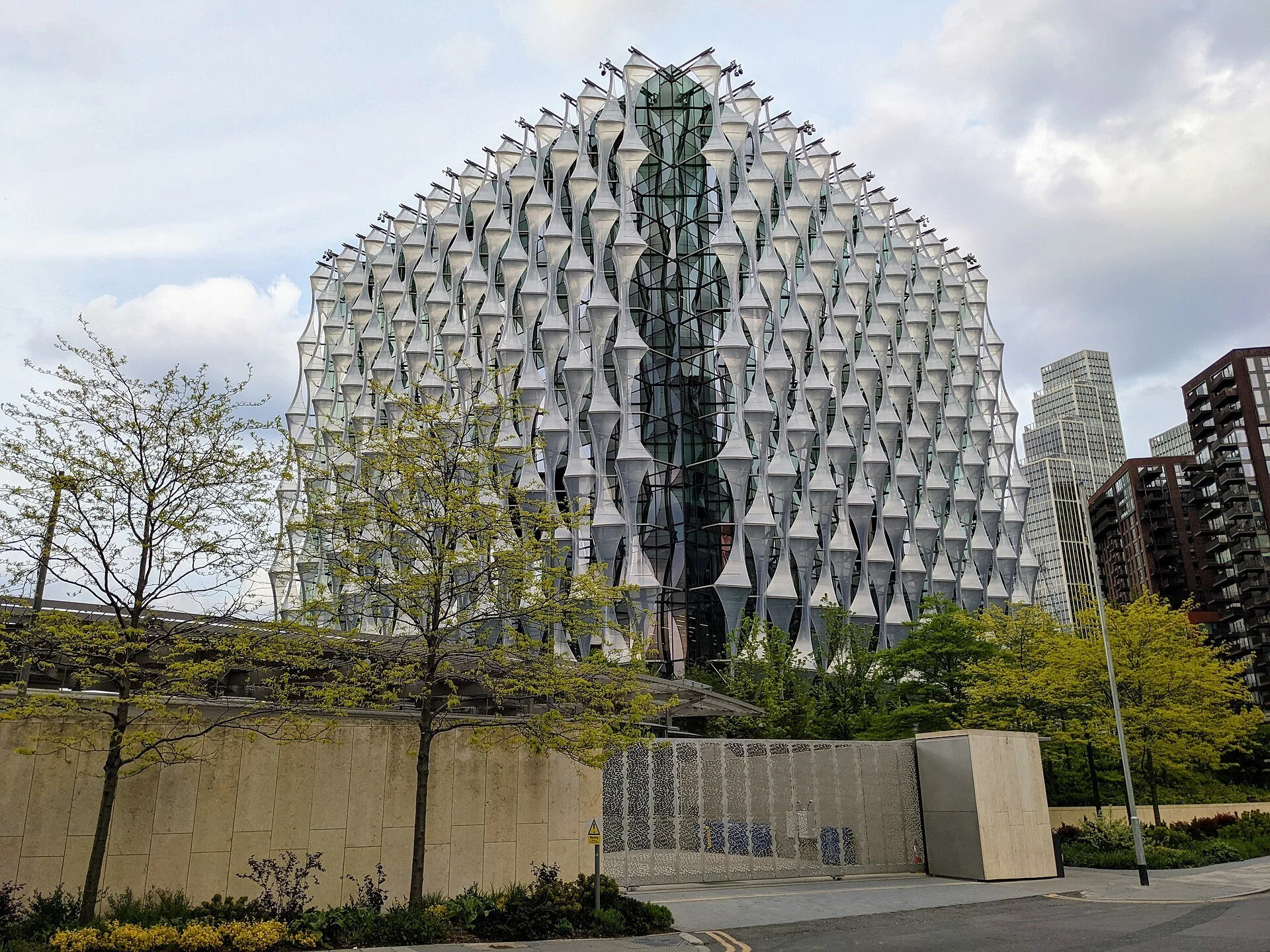
An embassy is one the most consequential public buildings the United States ever constructs because it is the one most of the world will ever see. A courthouse in Salt Lake City speaks to the citizens of Utah. An embassy overseas speaks for the whole Republic, to a foreign nation, in that nation’s own capital. It is the face America presents to the world.
The National Civic Art Society holds that principles similar to the ones we have advanced for U.S. courthouses and federal office buildings should apply with equal force to the buildings that represent us overseas, and that the diplomatic building program should be reformed accordingly.
As NCAS has maintained, many modern federal buildings are not even visibly identifiable as civic buildings. Nowhere is this more true than in the diplomatic portfolio. Our recent embassies and consulates could be mistaken for regional distribution centers, airport terminals, or corporate campuses. They are legible as bureaucracy. They are not legible as America. A building that represents a sovereign republic should announce what it is without a sign on the gate. It should possess dignity, permanence, and the capacity to inspire. These are not decorative afterthoughts. They are the building’s diplomatic function.
NCAS holds that American diplomatic buildings should be more frequently designed in the classical and traditional vocabulary, developed with genuine attention to the receiving country’s own architectural inheritance.
The spring 2026 issue of City Journal features an article by National Civic Art Society Research Fellow Theodore Dalrymple, “Ambassadors of Ugliness.” In his piece, Dalrymple focuses on an often-overlooked form of U.S. government architecture: American embassies and consulates.
“The architecture of recent American embassies lacks beauty and dignity,” he writes. Embassy buildings, he continues, “are symbolic of their countries—their taste, power, ambition, prestige, and position in the world.” An ugly embassy, in Dalrymple’s view, suggests “an ugly country, or at least one without taste.”
In his article, Dalrymple examines several recent embassy and consulate projects, including the U.S. Embassy in London, the new American consulate in Milan, and embassy projects in Lima, Beirut, and Hanoi. His essay raises a broader question central to NCAS’s work: whether government architecture should be judged only by security, function, and professional fashion, or also by beauty, dignity, and the public meaning of what America builds.
Dalrymple recalls Franklin Roosevelt’s 1939 observation on public architecture: “We are seeking to follow the type of architecture which is good in the sense that it does not of necessity follow the whims of the moment but seeks an artistry which will be good for all time to come.”
That standard remains a worthy one for American public architecture, at home and abroad. Read the full essay in City Journal here.