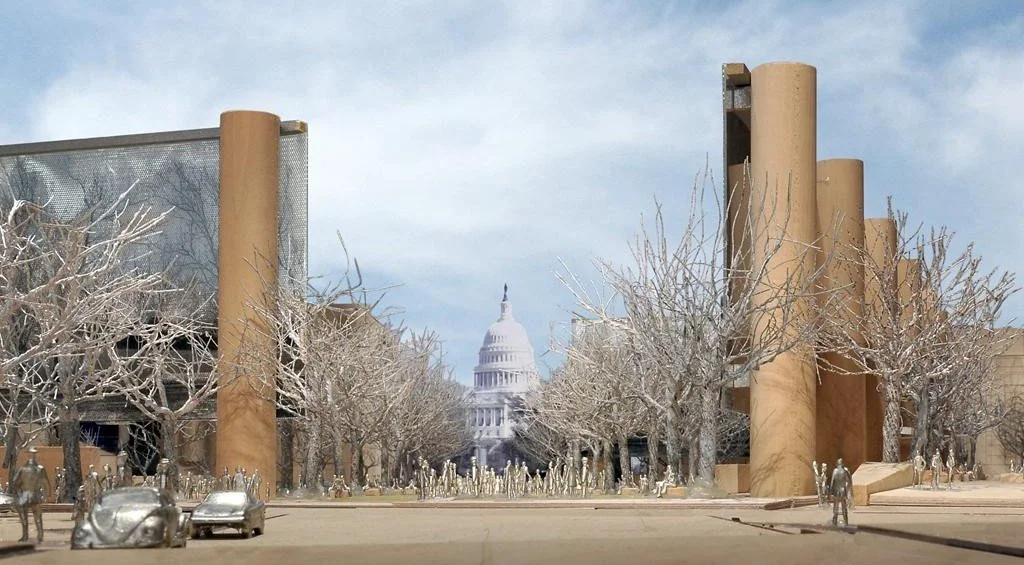
Frank Gehry’s Original Design for the Eisenhower Memorial
On December 13, 2025, National Civic Art Society president Justin Shubow just published an essay in National Review on Frank Gehry's legacy, including the Eisenhower Memorial.
As background: In 2011, NCAS launched and led a six-year campaign to stop Gehry’s design for the Eisenhower Memorial, located in Washington, D.C. Until NCAS’s initiative, the memorial had been flying under the radar and was a fait accompli. The Society brought the design to national and congressional attention.
NCAS published a 150-page report by Shubow on the design that detailed the flaws in the competition, design, and federal approval process. The report was quoted in a front-page story in The New York Times as well as by members of Congress. NCAS twice testified in the U.S. House of Representatives about the memorial, and published numerous articles about it.
The organization also put on events (including with Susan Eisenhower, spokesperson for the family) and held a counter-competition for a classical alternative to Gehry’s design. For a RealClearPolitics article on NCAS's campaign, see here. For an academic article on the Eisenhower Memorial saga, including NCAS's role, see here.
Shubow's essay begins:
Frank Gehry, the most famous and lauded architect in America, died last week at the age of 96. He exemplified the “starchitect,” a heady mix of celebrity, brand-name design, and signature aesthetics meant to wow. With perhaps false modesty, he complained about being “geniused to death.”
Shubow later writes:
Art and architecture was for Gehry a form of self-expression, which explains why he was such a poor choice for his only completed project in Washington, D.C.: the National Eisenhower Memorial. Gehry the self-portraitist agreed to take on the task of capturing the essence of someone else, someone far different. It was an odd pairing. The flamboyant Southern Californian was required to lionize a stolid Midwesterner who hated modern art. Just as bad, the purveyor of architectural chaos was working in a city hallmarked by classical order. . . .
Ultimately, Gehry was forced to remove the two smaller tapestries (leaving two free-standing cylinders like smokestacks) but threatened to strip his name from the memorial if the main tapestry was eliminated. He also added figurative statues to his design: wooden, hyper-literal tableaus of Eisenhower as president and Supreme Allied Commander. The barefoot boy was replaced by a statue of a teenage Eisenhower, with odd orangutan proportions, shunted off to a corner. . . .
When you visit the memorial during the day, the image on the tapestry — a scribble scrabble sketch by Gehry himself—is not even apparent. At night, when the screen is illuminated, it is impossible to tell what is depicted other than abstract expressionism with Gehry’s “signature” hand-drawing on it.
Reviews of the memorial have not been kind. New York magazine’s Justin Davidson, despite being highly sympathetic to Gehry’s oeuvre, called the design “a wan anticlimax . . . a work of civic architecture that fails to quicken the patriotic pulse or add much to the landscape of memory in downtown D.C.” Edward Rothstein likewise panned the design in the Wall Street Journal: “Some objects are inflated beyond all significance; others are so diminished they seem afterthoughts.”
But the most important review is the saddest one: Few people ever visit the memorial, despite its prime location across the street from the National Mall and Air and Space Museum, which gets 3 million visitors a year.
In his otherwise idolizing biography of Gehry, Paul Goldberger, addressing the memorial fight, wrote that the architect “felt few people in the architecture community seemed willing to defend him. . . . Frank, anxious as ever about his reputation, did not consider the possibility that many of his peers were simply not enamored of the memorial design, and that it was their architectural judgment, not any lack of loyalty, that was preventing them from speaking out. For all his lifelong worry about what people thought of him, it did not occur to him that the architects he respected, and who he knew respected him, might have simply viewed this one as a miss, as one of those moments when Babe Ruth strikes out.”
Read the full article HERE.