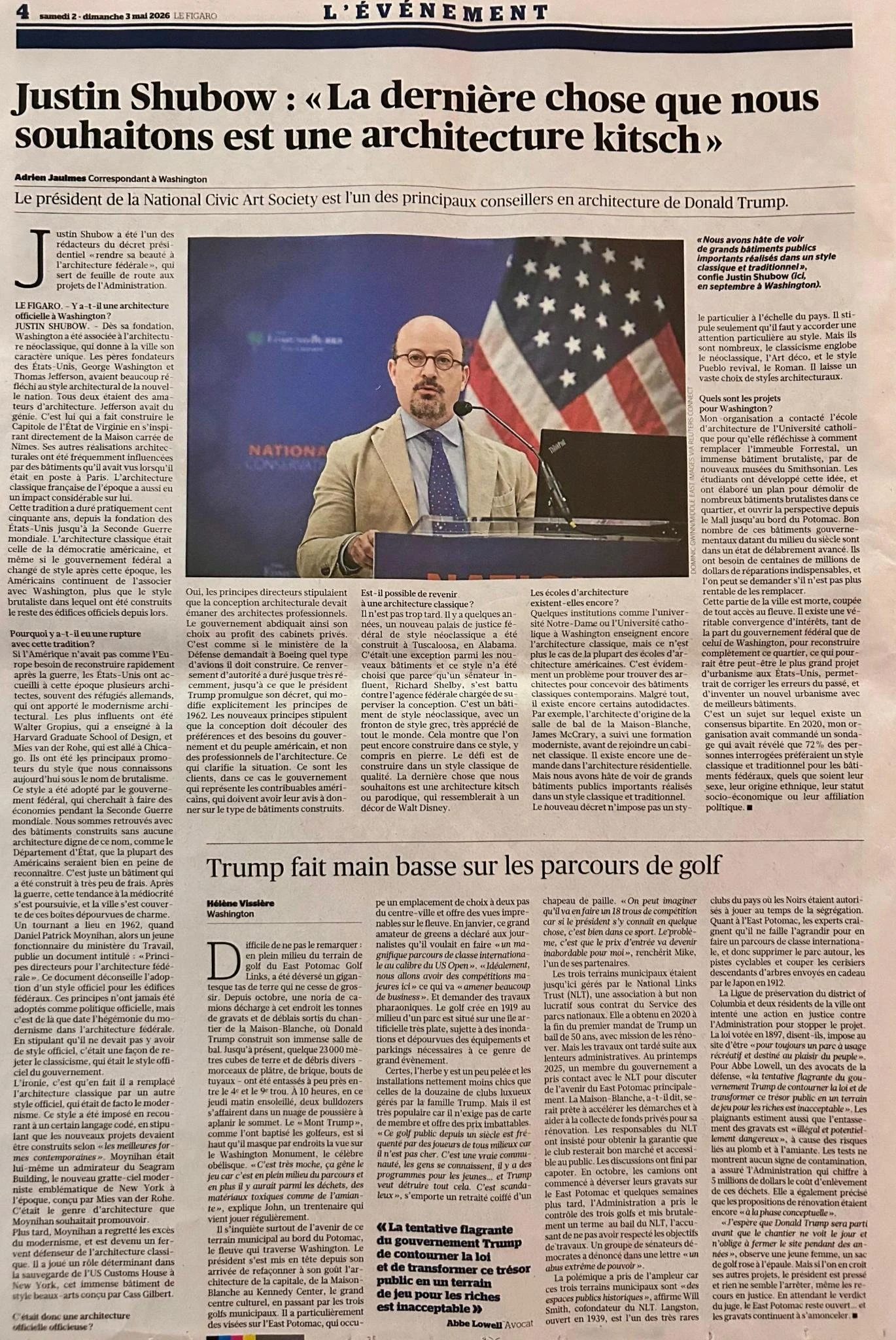
On January 21, 2026, The Wall Street Journal published an op-ed by National Civic Art Society president Justin Shubow in which he calls for the architecture of the new RFK Stadium in Washington, D.C. to be classical. See below.
***
Washington Needs a Stadium as Grand as Harvard’s
A classical Roman- or Greek-inspired arena would suit the capital’s spirit and history.
The largest private development in the District of Columbia’s history is under way: a new Robert F. Kennedy Stadium that will be home to the Commanders football team. At an estimated cost of $3.8 billion, it will replace the rusting, abandoned hulk that sits at the east end of East Capitol Street, fronting the Anacostia River. Given the stadium’s prime location, President Trump said the replacement is “going to be an architect’s dream.”
During a National Capital Planning Commission meeting last month, White House staff secretary Will Scharf said that he hopes the structure “incorporates architectural features in keeping with the capital more generally—classical, neoclassical elements that will align it with the capital that it will essentially overlook.”
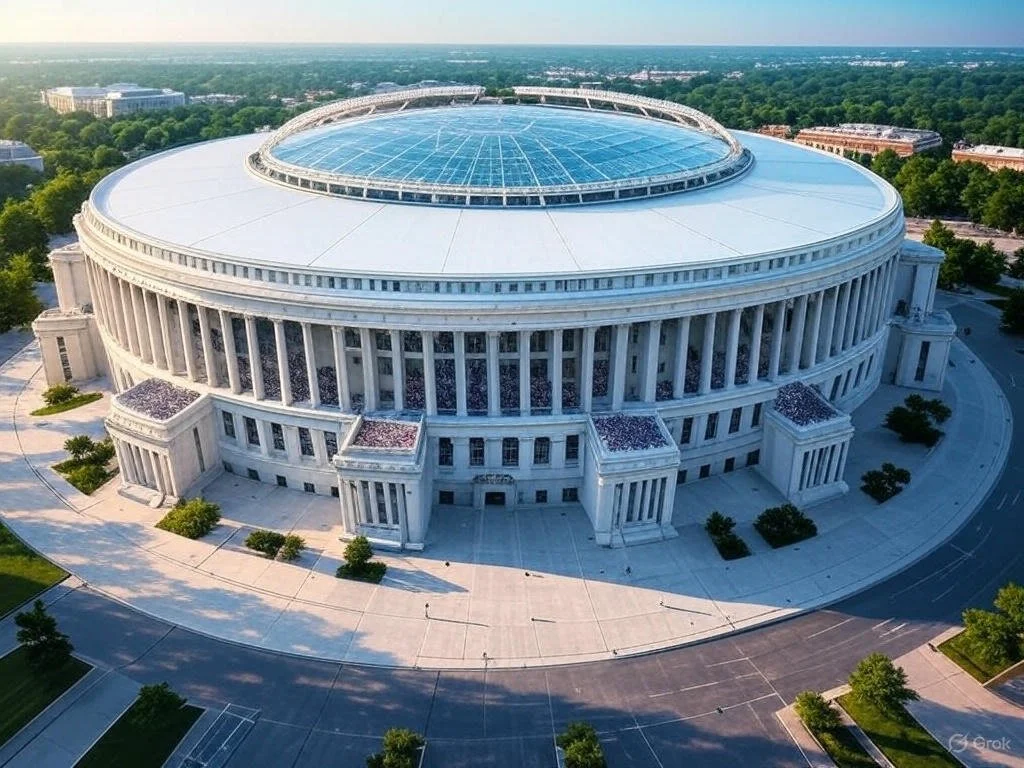
I hope so too. The project offers a once-in-a-century opportunity for Washington to achieve its potential as a classical city inspired by Republican Rome—the intent of George Washington and Thomas Jefferson.
The Roman influence runs deep. The U.S. Capitol was spelled with an “O” rather than an “A” in reference to ancient Rome’s Capitoline Hill. The tributary of the Potomac River cutting across the land was called Tiber Creek after the river that flowed through the Eternal City. The Jefferson Memorial and the Capitol itself are modeled on the Pantheon.
The capital is awe-inspiring thanks to Pierre Charles L’Enfant’s 1791 master plan, perfected by the 1901-02 McMillan Plan creating the National Mall and monumental core as we know them. A grand east-west cross axis defines Washington, running west from the Anacostia to the Capitol, through the National Mall, past the Washington Monument, and to the Lincoln Memorial at the Potomac.
Yet the capital falls short of its founders’ vision. The Capitol building ought to be the symbolic center of the city—as it is in the street grid with its four quadrants—but the avenue running east is underdeveloped. A classical stadium at its end would counterbalance the Greek-temple-inspired Lincoln Memorial at the opposite terminus. The Capitol would be the fulcrum.
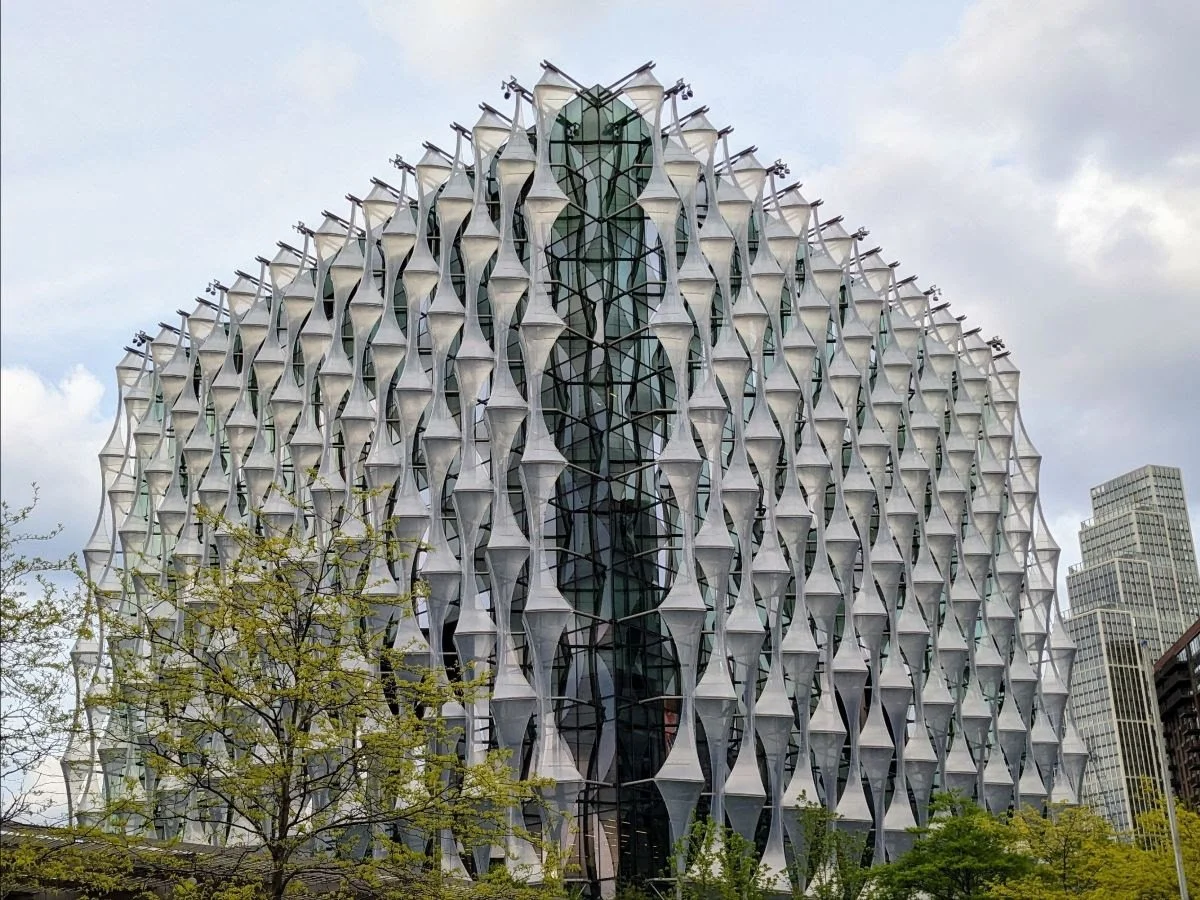
A classical stadium would be an iconic structure. It would invigorate fans and visitors. It would be lucrative for the team’s owners and a catalyst for neighborhood development. The design would stand out from other new stadiums around the world, many of which look like experimental modern art projects. The glitzy Sphere suits Las Vegas; a new football arena along classical lines would befit Washington, which Frederick Douglass praised for “its lofty domes and stately pillars.”
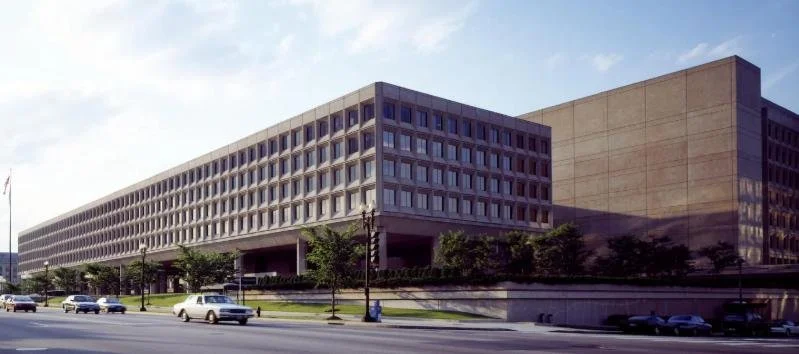
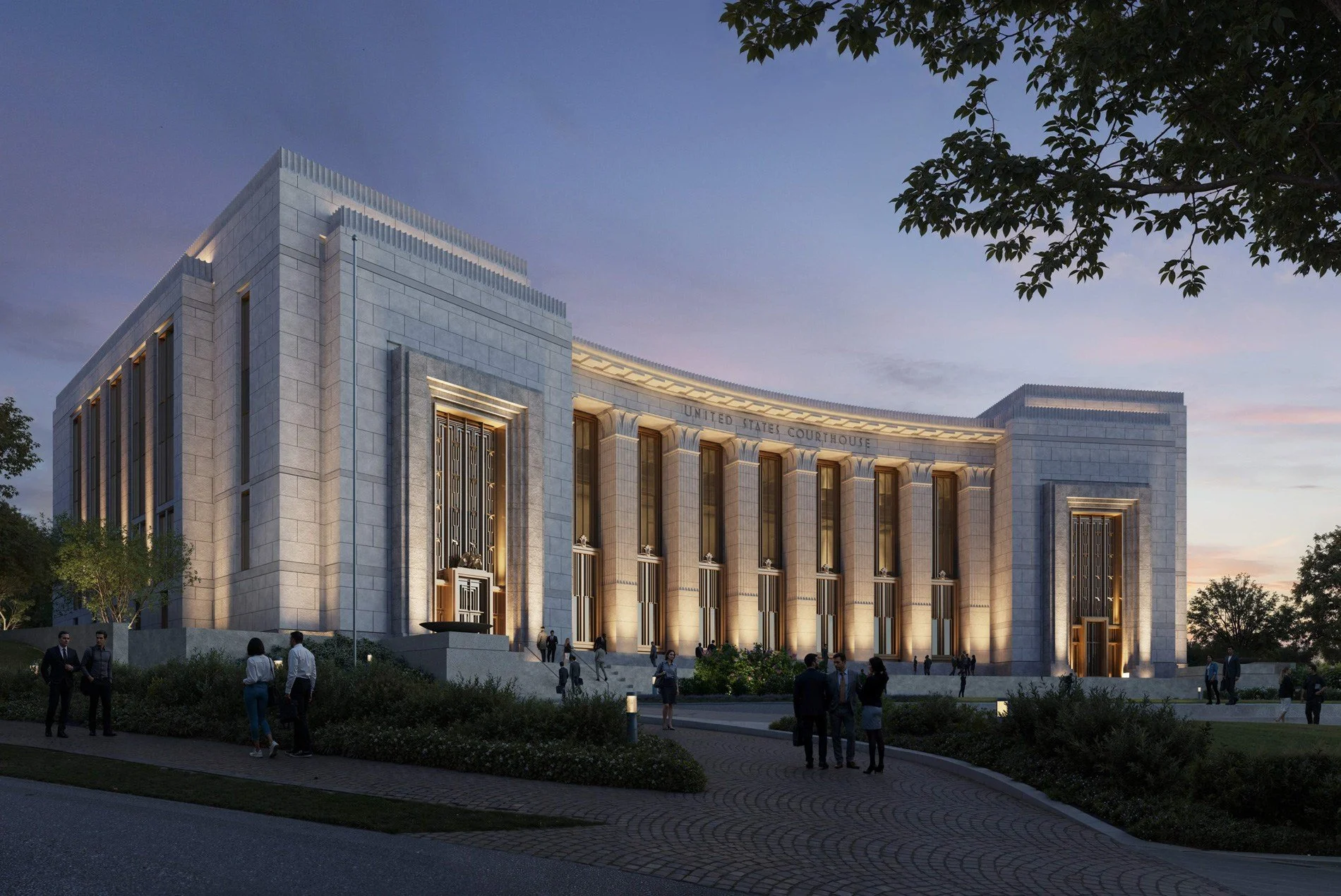
Building a classical stadium would comport with the spirit of Mr. Trump’s August executive order “Making Federal Architecture Beautiful Again,” which reorients the design of government buildings from modernist to classical and traditional styles. As that directive states, the Founders “wanted America’s public buildings to inspire the American people and encourage civic virtue. . . . They sought to use classical architecture to visually connect our contemporary Republic with the antecedents of democracy in classical antiquity, reminding citizens not only of their rights but also their responsibilities in maintaining and perpetuating its institutions.” The order recognizes that classical public buildings, monuments and memorials are popular with Americans, who associate them with our democracy’s highest ideals.
There’s also the question of civic urbanism—an approach to city planning that puts citizenship and community at the center. The new stadium will be the heart of a 180-acre mixed-use development likely containing housing and park space. Would Washingtonians rather live next to a structure that looks like a gigantic Martian spaceship or a work of beauty that reflects the genius loci, the spirit of the place? If there’s any doubt, the developers ought to survey the public. They could create renderings of modernist vs. traditional designs and let the people decide.
A classical stadium would echo another new, planned gateway to the city: the monumental Roman-inspired arch the president promises to build in the traffic circle near Arlington Memorial Bridge and the Lincoln Memorial. The magnificent proposed structure is reminiscent of the Arc de Triomphe in Paris and will celebrate America’s semiquincentennial. This arch will continue the aforementioned east-west axis to the far side of the Potomac.
The idea of a classical football stadium isn’t new to the U.S. Its many precedents include the Los Angeles Coliseum (a 1984 Summer Olympics site), Harvard Stadium and Chicago’s original Soldier Field. Other countries have also recently considered building classical stadiums. In 2023, an architecture firm proposed an elegant Colosseum-like rugby stadium in Bath, England, keeping with the city’s historic Georgian architecture.
There’s even precedent for such a project in Washington. In 1911, architect Ward Brown proposed building a marble-and-concrete Roman-style stadium that could seat 87,000 people at what is now the site of the Lincoln Memorial.
The location of the Robert F. Kennedy Stadium cries out for a horseshoe design open to the west, permitting spectators to look out toward a majestic vista and setting sun. The design could be modeled on the U-shaped Panathenaic Stadium in Athens—the quintessential example of pure classical architecture reconstructed in the second century and entirely clad in marble.
It doesn’t necessarily augur well that the Commanders have hired HKS, a modernist architecture firm that has designed a handful of new stadiums, as the lead designer. The team recently released initial renderings. Lamely alluding to classical columns, they’re uninspired, to say the least. But even a mega-firm that typically builds in a futuristic style can form a partnership with a design architect who’s an expert in classicism.
Working together, the Trump administration, the Commanders’ owners and other stakeholders have a rare opportunity to build a glorious stadium that will be a win for business and a gift to the city.