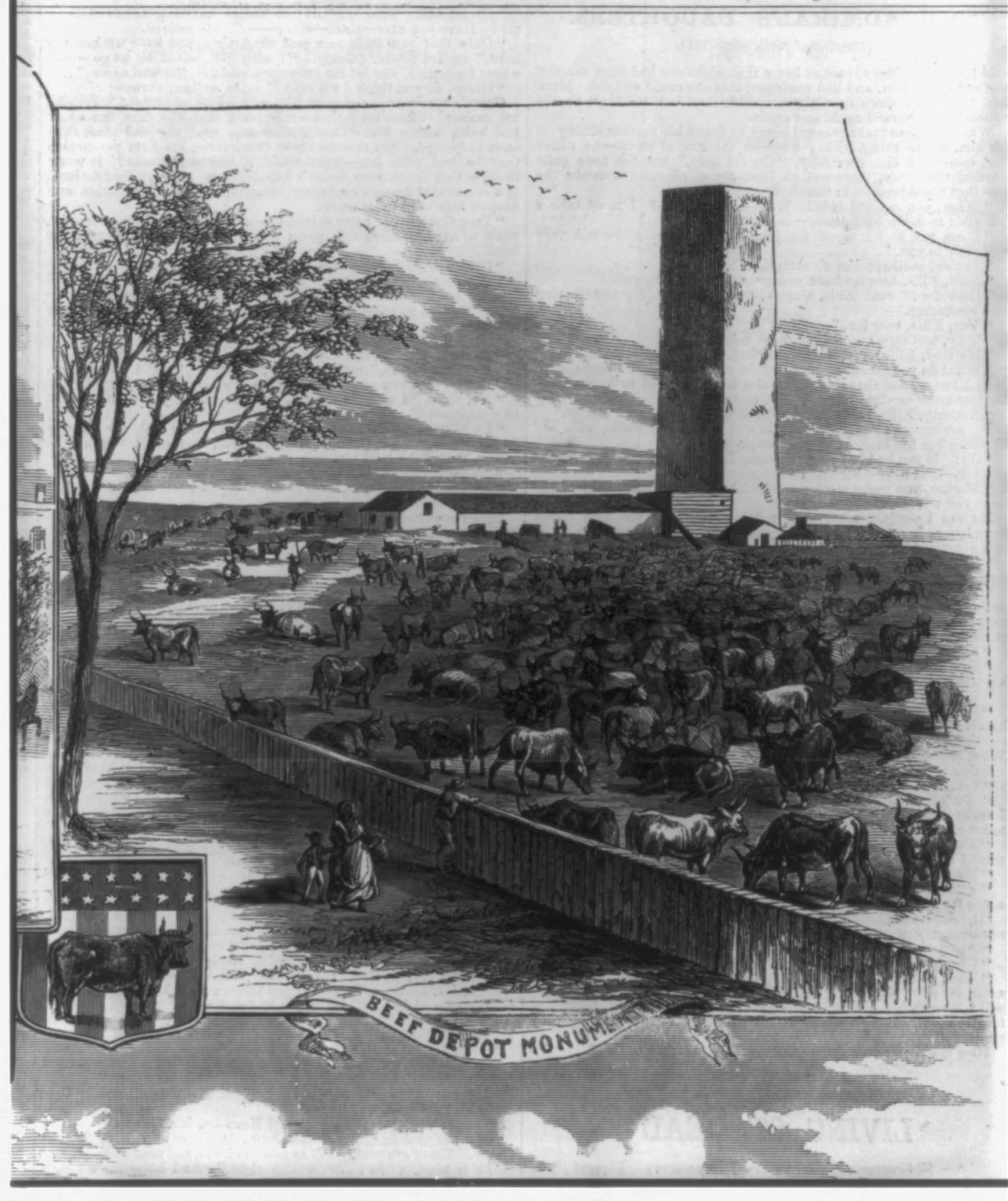
For a hundred years after L'Enfant proposed his plan for Washington in 1791, the city went largely unbuilt. Cattle grazed at the half-finished Washington Monument; a railroad station stood in the middle of the Mall.
In the first of a new series at TomKlingenstein.com, Justin Shubow, president of the National Civic Art Society, tells how L'Enfant, Washington, and Jefferson designed a capital meant to shape the character of a free people, how it was neglected, and how the stage was set for fulfillment.
The plan of Washington, D.C. is the greatest work of civic art in U.S. history. Even if they have never visited it, Americans can imagine it in their mind’s eye: two great axes crossing at the Washington Monument, anchored by iconic memorials and government buildings; and a matrix of wide boulevards, squares, and long vistas. It is a city of three colors: the white monuments, green lawn, blue reflecting pool and Tidal Basin. The sum total is an achievement that took 150 years to build. It is the product of two visionary comprehensive plans—the 1791 L’Enfant Plan and the 1901-1902 McMillan Plan—and the political will to complete them. It is a story of sweeping ambition, a century of neglect, and a classical renaissance. That revival is due to the City Beautiful movement, an alliance of ordinary citizens, political leaders, and artistic luminaries who believed that public design could instill civic virtue.
You can read the rest of the article HERE.